

FISH is a microscopic molecular-cytogenetic method that allows targeted examination of predetermined chromosomal regions/genes. In our laboratory, the FISH method is currently used for preimplantation genetic screening (PGS (PGT-A)) of selected chromosomes (usually the 5 most common whole-chromosome numerical abnormalities) and for preimplantation genetic diagnosis/testing of unbalanced forms of familial rearrangements (PGT-SR) of small extent, where the NGS method cannot be used.
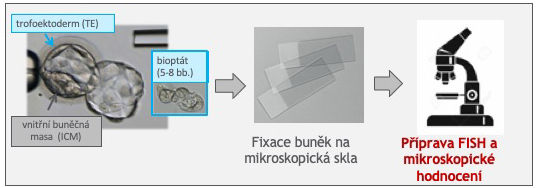
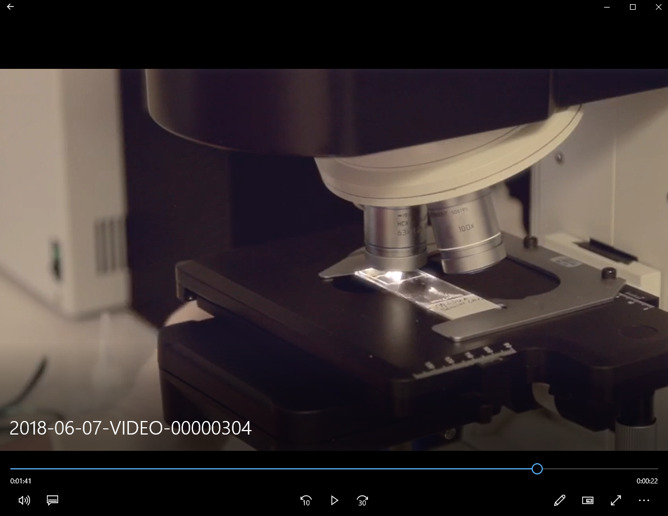
Principle of the FISH Method: The examination is conducted on cell nuclei fixed on a microscope slide. The principle of the method involves labeling several specific chromosomal regions with a fluorescently labeled probe complementary to the given DNA segment. Evaluation is performed using fluorescence microscopy. The method can only determine numerical changes in selected chromosomes or their parts, marked by the chosen fluorescent probe. When performing PGD (PGT-SR) to detect unbalanced forms of familial chromosomal rearrangement, it involves parts of chromosomes participating in this aberration. PGD (PGT-SR) by the FISH method is usually preceded by chromosomal examination of the parents to verify the accuracy of the proposed combination of fluorescent probes (so-called "set-up").
Limitations of the FISH Method: FISH cannot exclude any other diseases or developmental defects of the fetus that are not caused by changes in the number of examined chromosomal regions.
Schema of FISH Examination – PGT-A, PGT-SR
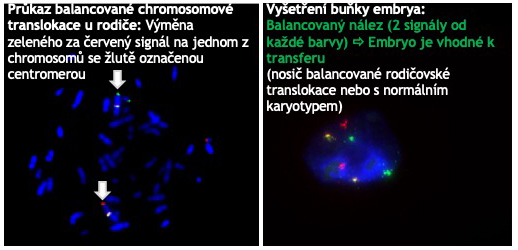
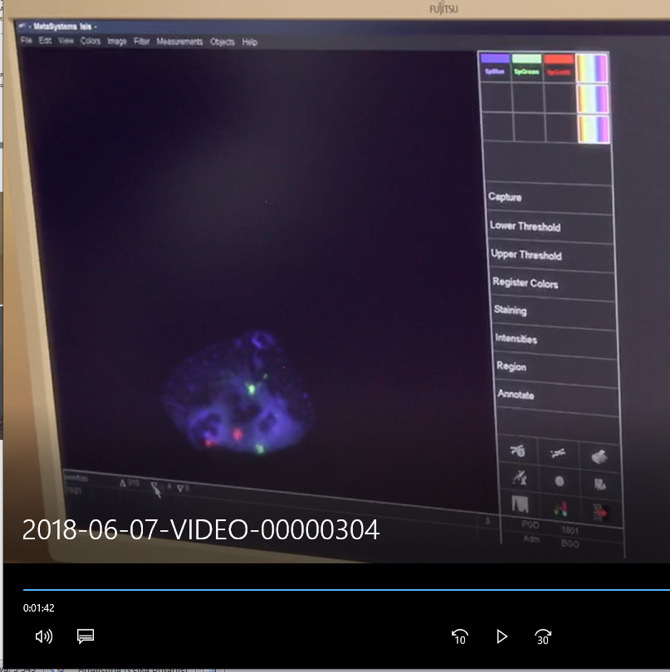
Example of PGT-SR results using the FISH method
 English
  Czech
Czech  German