

Former name PGS: Preimplantation Genetic Screening
Preimplantation genetic screening (PGS (PGT-A)) is a test focused on the chromosomal makeup of the embryo. It is known that one of the main causes of infertility in humans is the formation of embryos with an abnormal chromosomal set. Such embryos either do not lead to pregnancy at all (do not implant into the uterine lining) or lead to miscarriages or, in extreme cases, the birth of a child with disabilities.
With PGS (PGT-A), it is possible to distinguish embryos with a normal chromosomal finding from embryos with sporadic (i.e., de novo, non-inherited) deviations in the number of whole chromosomes or their parts (with so-called aneuploidies). "Chromosomally healthy" embryos are then transferred into the mother's uterus, significantly increasing the chances of achieving pregnancy and giving birth to a healthy child.
INDICATIONS FOR TESTING:
• Repeated miscarriages (2 times or more).
• Birth or miscarriage of a fetus with chromosomal abnormality.
• Repeated implantation failure after previous IVF cycles/embryo transfers (2 times or more).
• Significantly impaired sperm parameters in the partner.
• Use of sperm after TESE (sperm retrieval directly from the testicle) or MESA (sperm retrieval from the epididymis) for IVF.
• Condition after treatment of oncological disease with chemotherapy or radiation in one or both partners.
In addition to the main indications mentioned above, PGT-A can be performed as part of any IVF-ICSI cycle to increase the chances of achieving pregnancy and giving birth to a healthy child (in a self-paying regime).
TESTING METHODS:
Currently, we perform PGS (PGT-A) using next-generation sequencing (NGS) or fluorescence in situ hybridization (FISH).
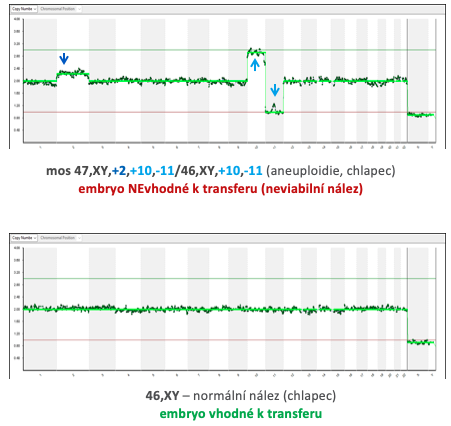
PGS (PGT-A) using next-generation sequencing (NGS) allows for the examination of more extensive quantitative changes (gains or losses) of genetic material across the entire genome, i.e., all 24 chromosomes.
PGS (PGT-A) using fluorescence in situ hybridization (FISH) is usually performed for only 5 chromosomes and is used exceptionally, according to the indication of the attending physician.
TISSUES EXAMINED:
The examination is standardly performed on trophectoderm cells taken on the 5th-6th day of embryo development, but it can also be exceptionally performed on blastomeres or polar bodies (more detailed info under this link).
COURSE OF THERAPY:
If you decide to undergo therapy with preimplantation testing, its course will be similar to "usual" therapy with IVF-ICSI. The only difference will be that a biopsy will be performed on the embryo on the 5th-6th day of development – that is, the removal of several trophectoderm cells. This sample will then be tested in a genetic laboratory, and the biopsied embryos will be frozen. Once the test results are available, the IVF-ICSI cycle will continue with the transfer of a healthy embryo.
see Course of therapy with preimplantation genetic testing
Examples of PGT-A results using the NGS method
 English
  Czech
Czech  German