

Former name PGD: Preimplantation Genetic Diagnosis for familial chromosomal aberration
Preimplantation genetic testing for familial chromosomal aberrations/rearrangements (PGT-SR) is a targeted diagnosis of unbalanced forms of specific familial chromosomal abnormalities that may lead to the birth of a child with disabilities or recurrent pregnancy losses. This examination is always conducted based on the indication of a clinical geneticist after evaluating the family history.
INDICATIONS FOR TESTING:
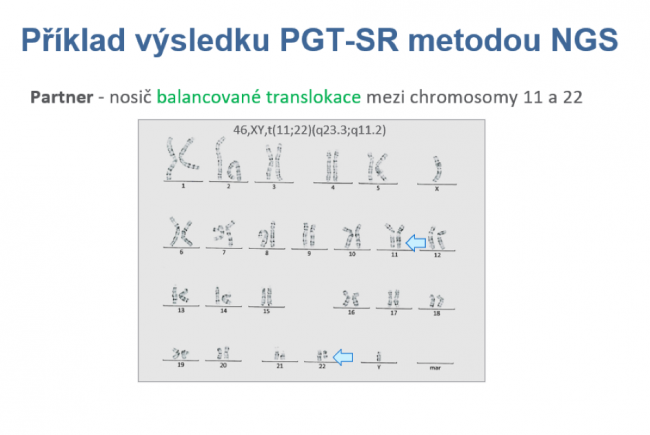
• Carrier of so-called balanced chromosomal rearrangement (usually translocation) in one or both partners.
• Presence of numerical changes in sex chromosomes (gonosomes), including mosaic forms, in one or both partners.
TESTING METHODS:
Currently, we perform PGT-SR using next-generation sequencing (NGS) or fluorescence in situ hybridization (FISH).
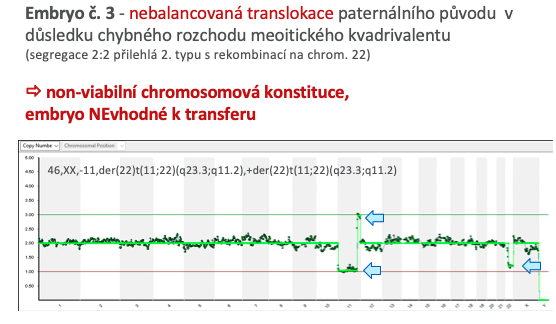
PGT-SR using NGS allows for the examination of unbalanced forms of familial chromosomal rearrangements of larger extent and simultaneous screening for quantitative changes in other chromosomes (PGT-A).
PGT-SR using FISH is used only for PGT-SR of unbalanced forms of familial structural rearrangements of small extent, where NGS cannot be used.
TISSUES EXAMINED:
The examination is standardly performed on trophectoderm cells taken on the 5th-6th day of embryo development, but it can also be exceptionally performed on blastomeres or polar bodies (more detailed info under this link).
COURSE OF THERAPY:
If you decide to undergo therapy with preimplantation testing, its course will be similar to "usual" therapy with IVF-ICSI. The only difference will be that a biopsy will be performed on the embryo on the 5th-6th day of development – that is, the removal of several trophectoderm cells. This sample will then be tested in a genetic laboratory, and the biopsied embryos will be frozen. Once the test results are available, the IVF-ICSI cycle will continue with the transfer of a healthy embryo.
 English
  Czech
Czech  German